
We’ve been using a simple question in our house for years, and it works better than it probably should.
There’s something a little addictive about having options…
Think about it outside of work for a second. Picking your favorite ice cream flavor. Choosing the appliance you want (or need) in your kitchen. Deciding when and how you’re going to tackle your to-do list. There’s a subtle sense of control that comes with it.
Not because the decision is life-changing… but because it’s yours.
And when that disappears? When it feels like there’s no choice at all?
Different experience entirely.
LEADERSHIP
When someone is told exactly what to do, even with good intent, it can land as pressure or compliance.
When someone is given a couple of choices, or even just a voice in the process, it shifts to ownership.
Same work. Different energy.
There’s solid psychology behind this. Self-Determination Theory points to autonomy (having choice and control) as one of the core drivers of intrinsic motivation. People don’t just want direction… they want some degree of say in how they show up inside that direction.
You’ve probably had the thought before:
“I don’t think they care what I think.”
Or,
“They didn’t even give us a choice.”
That feeling sticks longer than most leaders realize.
Now, to be clear, this is not a free-for-all. (I can feel some of you already picturing chaos in your next team meeting.) Leaders still need to set direction, make decisions, and keep things moving.
But inside that structure, there are more opportunities for choice than we tend to use.
Do you want to tackle this this week or next?
Which of these approaches makes the most sense to you?
If we’re rolling this out, what would you tweak?
Option A or option B?
Even something as simple as letting a team vote on a theme, a color, or how a meeting runs.
Are these big decisions? No.
Do they matter? More than you’d think.
Because they signal something important: your input matters here. Not all of the control lives at the top.
And over time, those small moments become the norm. More ownership. More engagement. More willingness to lean in instead of quietly checking out.
And yes, there will be moments where it feels like no matter what options you give, they won’t like any of them. That might be true.
Offer them anyway.
People don’t just want to do the work. They want to feel like they’re part of how the work gets done.
(And if they want to have a mild or hot opinion about it along the way… that’s usually a sign they care.) Keep cool and carry on!
LIFE
We’ve been using a simple question in our house for years, and it works better than it probably should.
It usually comes up when one of us is stuck on something, either work or home-life related. A comment that didn’t land right. A situation that keeps replaying. The kind of thing that doesn’t deserve this much airtime… but somehow gets it anyway.
Instead of going in circles, one of us will ask:
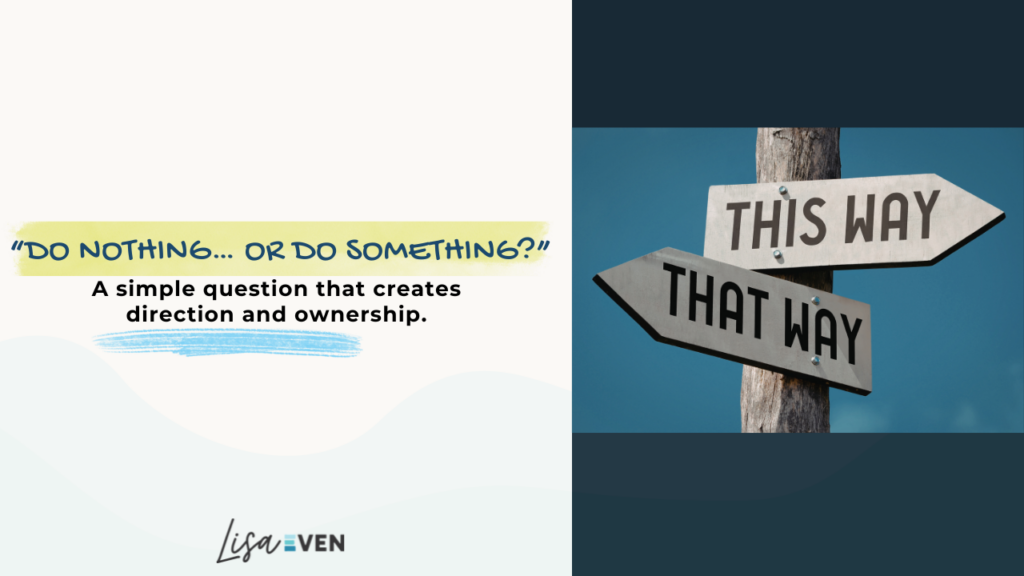
Do you want to do nothing, or do you want to do something?
That’s it.
It sounds overly simple. And yet… it works.
Because when your brain is looping, it rarely feels like you have options. It feels like you’re just stuck thinking about the same thing on repeat.
(And if we’re being honest, sometimes we kind of enjoy the loop for a minute. A little frustration, a little “can you believe this,” a little replay. Not our best moment, but a real one.)
This question interrupts that pattern.
It creates two clear options.
Option one: do nothing. Not avoidance… a decision. This isn’t worth my energy right now. I’m going to let it go on purpose. Maybe it’s not the right time. Maybe it just doesn’t matter enough.
Option two: do something. Have the conversation. Make the change. Address the thing instead of carrying it around all day.
There aren’t a hundred choices here. But there’s enough.
Enough to remind your brain that you’re not stuck.
We’ve started using it with our kids, too. Not in a formal “family meeting” kind of way. Just in those everyday moments when something feels bigger than it needs to be.
It helps them pause, think, and realize they actually have a say in what happens next.
And honestly, sometimes the best option is doing nothing… but deciding that on purpose instead of defaulting into frustration.
It’s a small question.
But it creates just enough space to move forward.
Have Good Ripple Effect,
Lisa