
There’s the professional voice (the one you answer the phone with or use during a presentation). The customer service voice…
I used to have to call my dad at work, before there were cell phones, to ask if I could go to a friend’s house. And I would usually have to talk to someone else first, a person who worked at the same company, and ask for my dad. I would get put on hold and then he would answer saying, “Randy speaking.”
It was always a little funny to me because he sounded so… well, professional. Not the same guy I sat on the patio with or ate dinner with.
It wasn’t until I got my first job that I understood how much our voices shift depending on the roles we’re playing.
Leadership
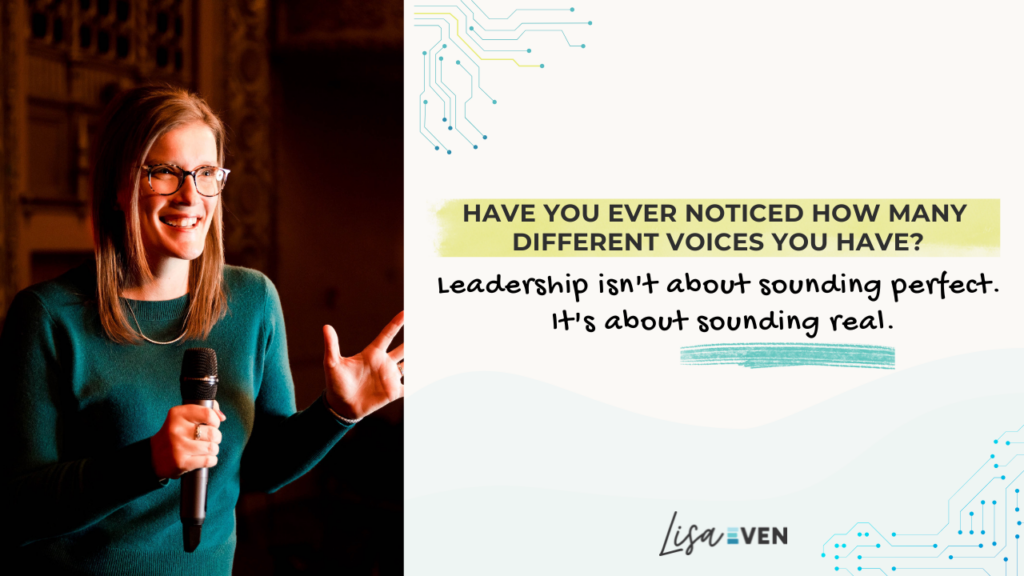
Have you ever noticed how many different “voices” you have?
There’s the professional voice (the one you answer the phone with or use during a presentation).
The customer service voice (trying to talk to the cranky customer service representative after hitting zero on your keypad ten times).
The “trying to stay calm in a stressful meeting” voice.
The “we need to circle back and align on deliverables” voice.
And then there’s the voice you use with people who know you best.
I was thinking about this recently because I caught myself slipping into what I can only describe as my “corporate leadership voice” during a conversation.
The one where I sound slightly polished and measured. Almost like a TV news anchor. The kind of voice that sounds like it’s wearing a blazer even when you’re not.
And to be fair, that voice can absolutely be useful.
Leaders often have to regulate emotion, create steadiness, communicate clearly, and navigate difficult conversations thoughtfully. Sometimes professionalism in your voice matters. Sometimes composure matters. Sometimes a measured response is exactly what the moment requires.
But I also wonder if there are moments where leaders become so practiced in “leader mode” that people stop feeling the human underneath it.
The conversation becomes polished instead of present.
Managed instead of connected.
Technically correct but emotionally distant.
And teams usually know the difference.
People can often tell when they’re getting the “approved corporate response” versus the real person in the room.
One of the things I continue to think about in leadership is this:
How do we remain professional without sounding robotic… or on the flip side, performative?
The leaders people tend to trust most are often the ones who still sound like themselves.
Not unfiltered.
Not emotionally impulsive.
Not inappropriate.
Just… human.
The leader who says:
“That’s frustrating.”
“I don’t fully know yet.”
“Let’s think through this together.”
There’s something powerful about leaders who don’t abandon professionalism but also don’t completely hide behind it.
And maybe part of modern leadership is learning how to communicate with competence and humanity at the same time.
Do you know your different voices?
And do you know when each one is actually helpful?
Life
Lately, I’ve also been thinking about this at home.
My kids are getting older now (one tween and one teen), which means our conversations are changing too. And I’ve noticed how easy it still is for me to accidentally slip into “mom teacher mode.”
The voice.
The reminders.
The fixing.
The subtle interrogation disguised as concern.
The life lesson tucked inside an ordinary conversation.
Sometimes they’ll start telling me a story and before they’re even done talking, I can feel my brain jumping ahead to:
“What lesson should they learn here?”
“What advice should I give?”
“What problem should I solve?”
And honestly… sometimes they don’t need a manager.
They just need their mom.
Not “mom voice.”
Just me.
Present.
Listening.
Curious.
Interested in who they’re becoming.
I think when kids are little, parenting requires so much directing, correcting, reminding, teaching, scheduling, monitoring, and repeating yourself 14,000 times about water bottles, shoes, and homework folders.
But as they grow, the relationship starts to shift.
You realize your role becomes a little less about controlling their world and a little more about helping them process the chaos, unfairness, confusion, disappointment, and complexity that life eventually throws at all of us.
And sometimes the most meaningful conversations happen when I stop trying to parent the moment and simply join it.
Not every conversation needs a lesson.
Not every emotion needs a solution.
Not every pause needs advice.
Not every moment needs my “mom voice.”
Sometimes people (kids, parents, friends, siblings included) just want to feel heard before they feel guided.
Do you have a voice that you use outside of work? And are you asking whether you need it? I’m still learning too…
Have Good Ripple Effect,
Lisa