
Have we gotten so good at preparing for what could go wrong that we’ve stopped imagining things going right?
I’ve come to realize that life trained me to be a bit of a cynic. Or maybe a realist.
It started when I was young.
- The first time a friend ditched me for another friend (my seventh-grade daughter is getting a taste of this right now).
- The first time someone lied to me, and I genuinely didn’t think they would. I remember one of my first bosses doing this, and I was gobsmacked.
- Or the time I followed someone’s advice, only to have it go terribly wrong.
And then life kept happening. Family health scares, small heartbreaks, disappointments, and things that didn’t work out the way I thought they would.
None of it was unique to me. It was just life. But those experiences added up. I developed a pretty thick skin and got really good at preparing…scratch that, predicting…what might go wrong.
I even wore my cynicism as a badge of honor. I’d been through things. I knew how the world worked. I wasn’t naive. I knew how to survive.
I remember a boss once laughing and calling me a “bubbly cynic.”
Which, to be fair, is pretty accurate. She encouraged me to stop always preparing for the worst, and I remember thinking, But isn’t that just being smart? Isn’t contingency planning helpful?
And if we’re being fair, the world isn’t making it particularly easy to be optimistic right now.
The news, the division, the layoffs, the economy, the politics, the pace of change, the technology (I feel like I’m learning another tool or program every week). And then there’s the laundry piling up and the dishes sitting in the sink.
Sometimes we collectively wonder, Is it always going to be like this? And that little voice in our heads is quick to respond, Yep! Get used to it, honey.
Before we know it, those experiences become the lens through which we see everything. We hear about a new opportunity and immediately list the reasons it probably won’t work. We walk into a difficult conversation already expecting the other person to react badly. Someone shares good news, and our first instinct is to remind them not to get their hopes up.
Sound familiar?
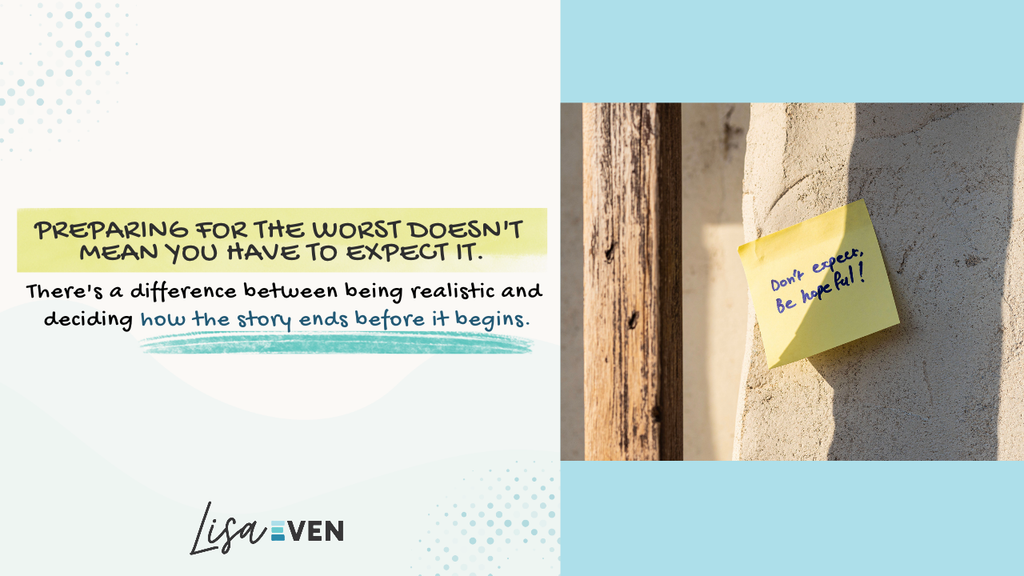
Sometimes that instinct protects us. But there’s a difference between preparing for something to go wrong and assuming that it will.
I don’t think I’ll ever completely lose my cynical side, and frankly, I don’t want to. It’s helped me navigate difficult things. But I also don’t want my past experiences to make all my future decisions.
So I’m working on a slightly different habit. When that little voice starts telling me all the reasons something won’t work, I’m trying to give equal airtime to another question: But what if it does? Or, do I actually know that yet?
Not because everything will work out. But because I don’t want to spend so much time preparing for disappointment that I forget to make room for possibility.
A THOUGHT FOR THE WEEK
The next time you catch yourself expecting something to go wrong, ask yourself: Am I preparing for a possibility, or have I already pre-decided how this is going to end?
There’s a difference between using our experience to make better decisions and letting our experience decide what’s possible.
Have Good Ripple Effect,
Lisa