
Repetition doesn’t just create habits. It creates routes.
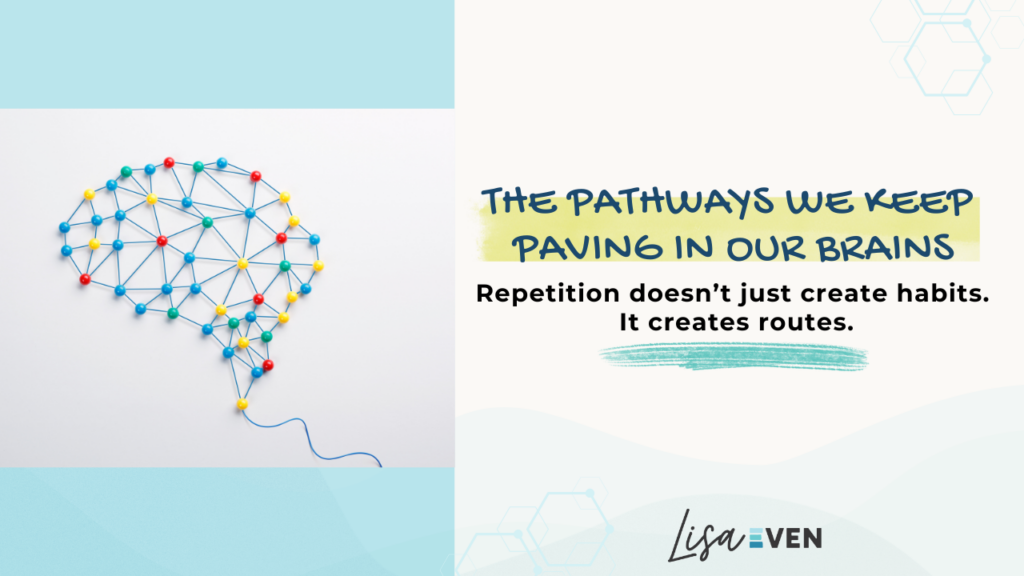
I’ve been thinking a lot lately about pathways.
Not the kind made of concrete or gravel (even though the weather has started to turn nice and I’m walking on those paths more lately), but the ones we create in our minds and bodies through repetition.
Because repetition creates routes.
And routes become easier to travel.
The fascinating thing about our brains is that they are constantly adapting to what we repeatedly think, feel, and do. Over time, our mind and body begin traveling those routes automatically, often without asking permission. It’s why habits can feel so natural. Why certain reactions show up before we even realize it. Why some people instantly move toward confidence while others immediately default to fear, doubt, frustration, or avoidance.
Those pathways get reinforced every single time we travel them… in life and leadership.
Leadership
I think this is incredibly important in leadership because teams experience our repeated emotional pathways and often our unconscious defaults.
Repeated stress and tension.
Repeated encouragement.
Repeated calm.
Repeated avoidance.
Repeated appreciation.
Repeated frustration.
Over time, leaders create emotional pathways inside a culture.
If a team repeatedly experiences criticism without recognition, people become guarded.
If meetings repeatedly feel chaotic or lacking in value, people stop preparing.
If ideas repeatedly get shut down, people stop contributing.
If accountability repeatedly disappears, trust starts eroding.
But the opposite is also true.
When leaders consistently create curiosity, structure, safety, accountability, and encouragement, teams begin traveling those pathways too.
Culture and team performance are often less about one giant moment or metric and more about repeated emotional experiences over time.
What we repeatedly model becomes what people expect.
What people expect becomes what they normalize.
And what gets normalized quietly shapes our teams.
Life
In life, we often sit in our thoughts and feelings so long that they can begin to feel permanent, factual, or fixed. But many times, they are simply well-traveled mental routes our brain has practiced over and over again.
If we repeatedly rehearse fear, our brain gets more efficient at finding fear.
If we repeatedly rehearse self-doubt, we begin shrinking before life even asks us to.
If procrastination becomes the pattern, hesitation starts to feel normal.
If we constantly focus on what’s broken, missing, frustrating, or not working, our minds become highly skilled at scanning for problems.
And to be fair… today’s world makes that incredibly easy.
There is always another headline.
Another comparison.
Another pressure.
Another reason to feel behind, uncertain, irritated, exhausted, or overwhelmed.
But the opposite is also true.
We can build pathways around peace, possibility, joy, and gratitude.
Around the meal we get to eat or the day we get to live.
Around courage.
Around confidence.
Around perseverance.
Around taking one small step instead of spiraling in overwhelm.
That doesn’t mean pretending hard things don’t exist.
It means becoming more intentional about which mental roads we keep paving.
Because eventually, the repeated thoughts become beliefs.
The repeated beliefs become behaviors.
And the repeated behaviors quietly shape the direction of our lives.
I think that’s why awareness matters so much.
Not so we judge ourselves for every negative thought, but so we can gently interrupt patterns that are no longer serving us and begin creating better routes forward.
Maybe that looks like catching yourself before spiraling.
Maybe it’s celebrating progress instead of only noticing flaws.
Maybe it’s spending less time rehearsing worst-case scenarios.
Maybe it’s simply asking yourself:
“Is this a pathway I want to keep strengthening?”
Our lives are shaped by what we repeatedly practice.
And small repetitions, over time, create powerful directions.
Have Good Ripple Effect,
Lisa