
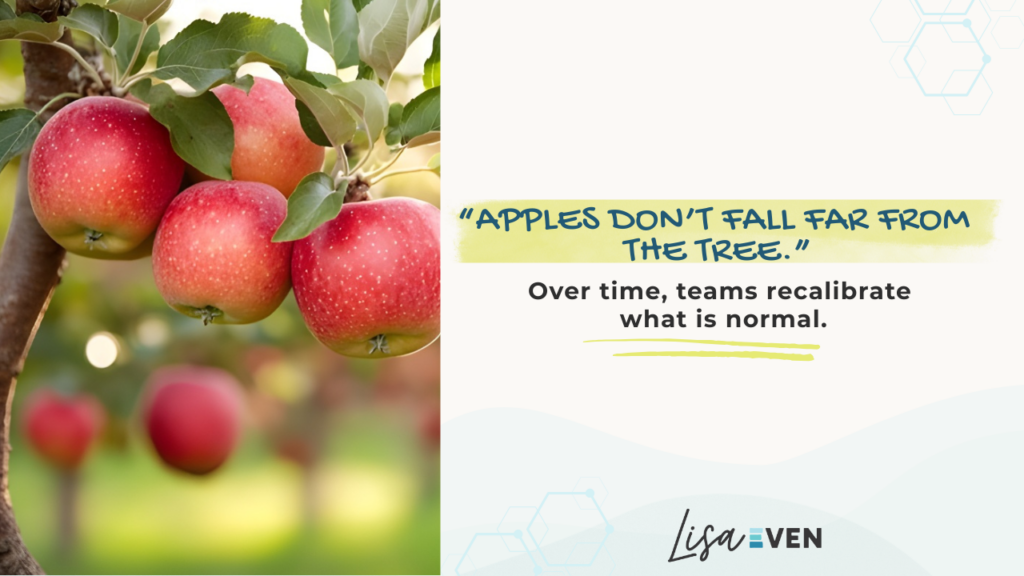
Over time, teams recalibrate what is normal.
Pouring coffee at a tiny café in small-town Iowa teaches you a lot.
How people take their coffee. How long they’ll stand and chat. And how often fruit becomes a personality or life assessment.
“Well, that one’s a bad apple.”
“Apples don’t fall far from the tree.”
Some sayings feel accurate.
Some feel like a stretch.
But one of them turns out to be more real than most, especially in leadership.
LEADERSHIP
There’s a well-known study in organizational behavior often referred to as the “bad apple effect.”
Researchers placed individuals into teams that were otherwise functioning well and introduced one person who consistently displayed a specific behavior. In some cases, that person was openly rude. In others, they withheld effort. And in some, they simply carried a negative tone into interactions.
Same team. Same goals. One variable changed.
That one person.
What happened next is what makes this study stick.
The teams didn’t just work around the behavior. They absorbed it.
Negative tone spread. Effort dropped. Communication started to fracture. In some cases, overall performance declined by as much as 30 to 40 percent.
Not because the team lacked capability, but because the environment shifted.
And here’s the part leaders can’t ignore.
This didn’t happen because of one big, obvious moment. It happened through small, repeated behaviors that went unaddressed. A comment here. A lack of follow-through there. A shift in tone that no one called out.
Over time, the team recalibrated what was normal.
That’s how culture actually changes.
Not through a mission statement or a kickoff meeting, but through what gets tolerated on a Tuesday afternoon.
When a behavior goes unchecked, it becomes part of the standard. And once the standard shifts, even strong performers adjust. Not because they want to lower the bar, but because the bar moved.
This is where leadership shows up in a very real way.
It’s in noticing the eye roll. The disengagement. The tone in the room. And addressing it early, while it still feels small and manageable.
Because one person can create a ripple effect.
But one unaddressed behavior can quietly reset the entire current of a team.
And by the time it shows up in performance, it’s already been happening for a while.
In another email, I’ll share how to address these behaviors, because it takes forethought, a steady tone, and a bit of finesse.
LIFE
Last week, we snuck away to Florida for spring break, and one of my favorite parts of any trip is watching my kids experience it. They’re all in. No hesitation. No overthinking.
And the life lessons come in bushels. It somehow ended up being warmer in Iowa than Florida, which still feels rude.
At a little fruit market, we each picked something to take home and share. My daughter chose mangoes. My son grabbed oranges. My husband went with limes. And I, someone who doesn’t love fruit and would choose chocolate nine times out of ten, picked homemade lemonade.
Everything looked delicious. Bright, fresh, like we made excellent life decisions.
Then came breakfast the next morning.
My husband sliced up an orange and handed out pieces. Within seconds, both kids made the same face.
“This is bad.”
“It’s so sour.”
We all tried it, assuming they were being dramatic. They weren’t. It looked perfect, and it was anything but.
And honestly, it felt like a real-life version of the bad apple effect.
Sometimes things look great on the outside and don’t deliver. Sometimes what you’re excited about falls flat. And sometimes the moment that matters most isn’t the setup, it’s what you do next when things don’t turn out the way you expected.
That’s the pivot point.
Do you dwell on it, or do you adjust?
Do you let one sour moment shape the rest of the experience, or do you reset and move forward?
One moment can make an impact.
But it doesn’t have to define the whole story.
Have Good Ripple Effect,
Lisa