
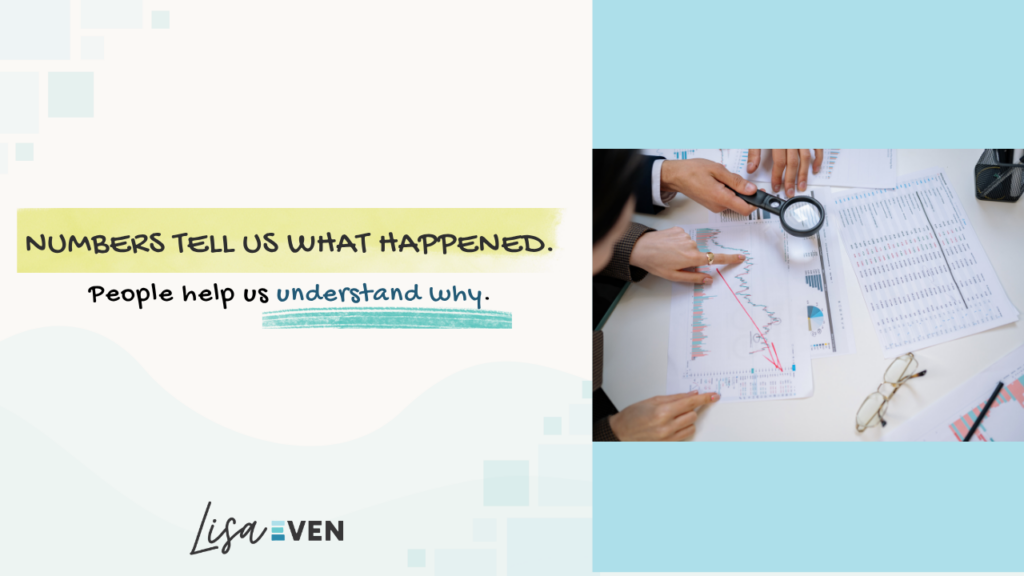
Metrics tell us what happened. The people closest to the work can help us understand why.
Have you ever walked into a place where everyone else seemed to know the routine, yet you felt like you had somehow missed the orientation?
Being the new person has a funny way of helping you notice what everyone else has stopped seeing.
Leadership
One of my earliest monthly meeting rituals (aka experiences) in corporate America fascinated me.
At the beginning of each meeting, neatly collated stacks of crisp white paper filled with numbers would make their way around the conference room table. Today it is all electronic, but back then, every meeting began with paper.
Each person in a black or gray suit would grab a packet, pass it to the next person, flip through a few pages, tap a pen on the table, and quietly mutter, “Hmm.”
It almost felt ceremonial.
Then the seemingly most important person in the room would walk to the front, straighten their jacket, pick up the presentation clicker, and begin. The first slide would appear on the screen displaying the exact same numbers we had just been handed.
Everything about it felt orderly and predictable. It reminded me a little of a church service. Everyone knew what came next. Stand. Sit. Kneel. Sing. Sit. Stand.
As someone still new to the corporate world, I remember thinking, This is an interesting thing to watch.
The presenter moved slide by slide through the data. At first, I assumed their role was simply to explain what was working, what was not, and what needed attention.
Then the finance team would present. Different data. Different lens. Same ritual.
Then another department. Different numbers. Different lens.
What I started to notice was that everyone loved their numbers because those numbers reflected their perspective.
Finance viewed the business through a financial lens. The employee engagement team viewed it through the employee experience. Operations viewed it through execution.
Each team shared its slice of reality, said thank you, and sat back down.
That is when my internal dialogue started kicking in. It is great that we are looking at the numbers through your department’s lens, but where is the conversation about why they look this way?
What is happening behind these metrics? How do departments influence one another? What are employees saying? Did anyone ask the people closest to the work?
I found myself wanting less reporting and more understanding.
Eventually, the final slide would appear. “We’ve got some work to do.” Papers shuffled, people stood, and conversations moved into the hallway. Meeting over.
Looking back, I do not remember many of the numbers. I remember what it took to change them.
Numbers told us what happened. People helped us understand why.
Whenever one of my team’s metrics dipped, I became Curious George. I would go straight to where the work was happening to observe, ask questions, and learn from the people doing it every day. I wanted to understand the people, processes, and technology shaping the results before deciding what needed to change.
My first goal was to paint a fuller picture of what was happening. Then I could build a plan to improve it.
The next time you are reviewing results, whether financials, engagement scores, customer feedback, or performance metrics, try adding two questions:
- What is the story behind these numbers?
- And who can I learn from about how to improve them?
Go to where the work gets done. Listen before you decide what needs to change.
Life
The more I have thought about those meetings, the more I have realized they were not just about business.
We all walk through life wearing our own department glasses.
Parents see the world differently than teenagers. As the mom of a tweenager and a teenager, I am reminded of that almost daily. Engineers notice different things than marketers, and optimists and skeptics can experience the exact same event and leave with completely different conclusions.
We tend to see the part our experiences, responsibilities, expertise, and assumptions allow us to see.
That has made me a little slower to decide what something means, a little quicker to ask another question, and a little more willing to get closer to the people living the story instead of assuming I already know it.
I am already thinking about when I can sneak in a question like, “What is something adults misunderstand?”
I have a feeling her answer will teach me something I could never learn from my own perspective.
Have Good Ripple Effect,
Lisa