Doesn’t it feel like everything is coming at us at once? Emails. Decisions. Problems. People. Expectations. We spend our days reacting, fixing, adjusting, and holding things together, often without realizing how much energy and sanity that constant responsiveness (being on duty) costs us.
At work, it shows up as firefighting. In life, it shows up as mental overload. Different arenas, same pattern. We are busy managing what is urgent. And honestly, that works for a while. Checking things off the list or saving the day can feel productive and even fulfilling. Over time, though, it becomes a slow burn.
Leadership
I was sitting in my gray walled office with my three supervisors, because hospital offices tend to be slightly stuffy and bland. One was a 30-year employee new to leadership, one was a seasoned leader, and one was just starting out.
We had been together a little over a year. We had survived our first budget season, engagement survey, and client satisfaction review. By that point, we were running on fumes.
Our metrics were the okayest I had ever seen. Right in the middle.
We had dashboards, goals, and good intentions, but everything felt harder than it should.
Collaboration across the team felt slightly awkward and forced. Productivity was inconsistent. And no matter how many good jobs and attaboys we handed out, progress was slow.
It felt like we were stuck in a sloth like loop, doing the same thing every day while expecting a different result.
That is when I realized we were operating in only three modes.
The Firefighters, reacting to the crisis of the day.
The News Reporters, updating dashboards and KPIs as if the team did not already live those numbers.
The Cheerleaders, handing out encouragement and praise, hoping the team would feel how much we cared.
We were busy, but not necessarily effective. And under closer inspection, we were not really leading anything. We were managing activity. Reacting. Putting out fires.
So I asked a question that changed the game.
What if we stopped reacting and started thinking and acting differently? What if we were more strategic?
My supervisors’ faces said it all. Confusion. Skepticism. Eyebrows scrunched. But I kept going.
Being a firefighter, reporter, and cheerleader are important roles. They just cannot be the only ones we play.
We needed to be proactive and intentional. We needed to set clearer expectations and define what good and great actually looked like for us. Our version of a mission and vision.
So we carved out time (90-minutes) to brainstorm and create shared language. Simple words and phrases that described the attitudes, behaviors, and beliefs we wanted to see. We created a slide deck to introduce our thinking. The plan was to invite the team to add their own language in small groups at the next staff meeting.
That shared language, our team statements and house rules, became our anchor.
We infused it into meetings, projects, hiring, one on ones, and performance reviews. It gave us something steady to steer toward instead of constantly reacting to the waves.
That is when we started to lead instead of just manage.
Where are you firefighting instead of leading this week?
Try this. Wipe your to do or to fix list clean for ten minutes and ask:
How can I be more strategic instead of reactive?
What are we actually trying to create?
How could I introduce this idea to my team and what input could they offer?
That one shift changed everything. We stopped defaulting to firefighting, reporting, and cheerleading, and started taking ownership of our time, energy, and influence.
Life
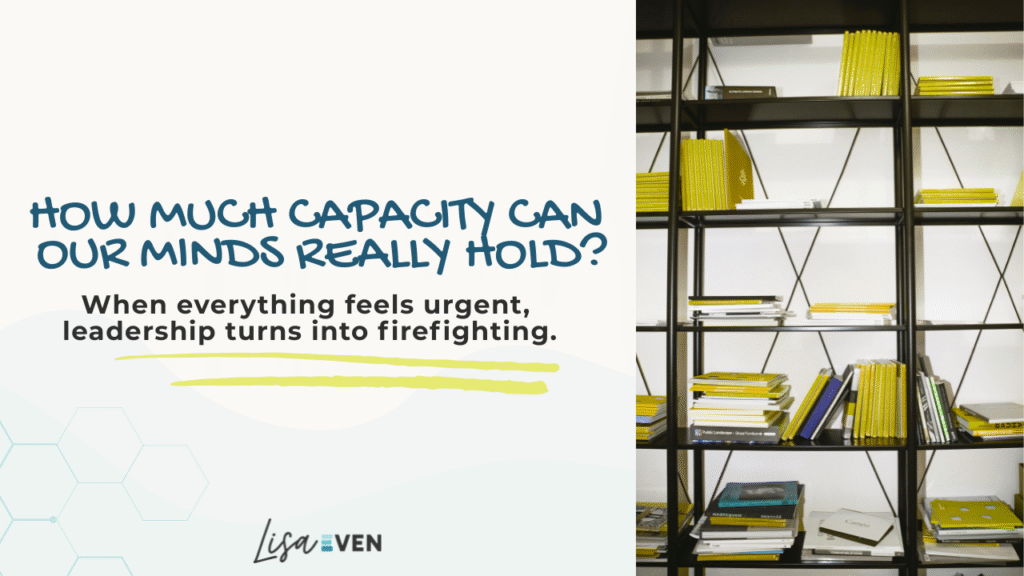
Lately, I have been thinking about how much capacity our minds can actually hold and why it looks so different from person to person.
I keep picturing the brain like a grocery store. Shelves lined with all kinds of products. Boxes, bags, liquids. Some neatly organized, others shoved wherever they fit. Thoughts, worries, plans, responsibilities, emotions all stacked together.
And just like a real store, there is a limit to how much those shelves can hold before things start tipping, spilling, or falling apart.
Sometimes the issue is overload. Too many products. Too many things we are trying to remember, prepare for, worry about, or get ahead of.
Other times, the problem is the opposite. One item takes up nearly all the shelf space. One situation. One stressor. One unknown. It crowds everything else out and quietly drains more energy than we realize.
What I have been noticing is how often we do not consciously choose what goes on our shelves. We let things land there by default. Other people’s expectations. Future what ifs. Overpreparing disguised as responsibility.
And then we wonder why we feel mentally tired even on days that do not look that full.
Lately, I have been trying to be more intentional about my inventory.
I want a balanced store. Enough productivity to feel forward motion. Enough stress to stay engaged, but not overwhelmed. Enough discernment and contemplation to make thoughtful decisions instead of reactive ones. Enough daydreaming to imagine what could be. Enough joy to keep things light. Enough excitement to stay curious.
But not so much of any one thing that it crowds everything else out. And definitely not so much perseveration on one issue that it turns my whole mental store into an emergency zone.
Mental strength, for me, is starting to look less like powering through and more like tending the shelves. Noticing what is taking up space. Deciding what deserves to stay. And giving myself permission to remove what no longer needs to be stocked.
Because a well run store is not empty. It is not overflowing. And it definitely is not on fire.
It is intentional.
Have Good Ripple Effect,
Lisa